


Published by Alfa Vedic
Why most plant proteins are built on the same two or three ingredients, and what that means for your gut.
Why Does Your Plant Protein Leave You Bloated?

By Dr. Barre Lando, D.C.
Founder & Formulator, Alfa Vedic
Updated October 29, 2026 4 min read

You did everything right this morning. Workout done. Shake down. Out the door on time.
Then, twenty minutes into your 9:00 meeting, your stomach starts making itself known. Tight. Puffy. Gurgling loud enough that you shift in your chair and hope nobody heard.
You chose plant protein to feel better. So why does it so often feel like this?
Plant protein isn't the problem
Plenty of people do great on plant protein. Choosing it is a reasonable call, whether for digestion, ethics, or allergies.
The issue is which plants. Walk down any supplement aisle and flip the tubs over. You'll see the same short list again and again: pea, soy, brown rice. Legumes and grains, because they're cheap and high-yield.
For a lot of people, those sources are exactly where the bloating starts. Add the gums, thickeners and sugar alcohols used to make them taste and mix better, and you have a shake your gut has to fight with.
What your body actually needs from a protein
A protein powder has one obvious job: deliver amino acids so your muscles can repair and grow.
But how you feel after a shake depends on more than the protein number on the label. It depends on how well the protein agrees with you, whether you're getting the full spectrum of amino acids, and what else comes along with it.
The overlooked part: recovery has more than one bottleneck
When someone says their protein "just doesn't sit right," I look at four things.
Source
Is it built on legumes and grains that commonly cause digestive trouble?
Completeness
Does it deliver the full amino acid spectrum, including BCAAs?*
Recovery
Is there antioxidant support for the stress a hard workout creates?*
Hydration
Are electrolytes coming along, or does the shake leave you depleted?*
Most plant proteins solve for the protein number and stop there.
The Life Force Protein approach
Life Force Protein™ No.1 starts from a different place. Instead of pea or soy, it's built on organic hemp and a blend of fruit-seed proteins, then rounded out with tocotrienols and coconut water.
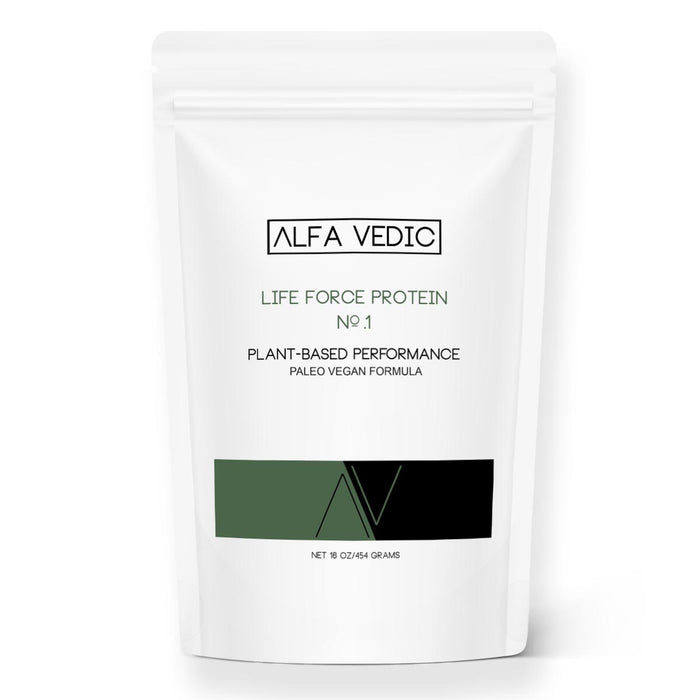
The ritual: one to two scoops in 4 to 8 oz of water or juice, or blended into your smoothie. It tastes good enough that our team eats it by the spoonful straight from the bag.
The ingredients, and why each one is there
Organic Hemp Seed Protein · the foundation.
Hemp delivers a complete amino acid profile along with natural fiber, from a seed rather than a legume.*
Fruit-seed proteins · Blueberry, Cranberry, Raspberry, Grape, Black Cumin.
Seeds that would normally be discarded are rich in protein and polyphenol antioxidants. Together they round out the amino profile and add antioxidant activity most proteins don't have.*
Tocotrienol-rich rice bran solubles · recovery.
Tocotrienols are a form of vitamin E included for antioxidant support. Exercise research on tocotrienol-rich vitamin E does not establish the effects of this finished protein blend.*
Dehydrated coconut water · hydration.
Natural electrolytes and trace minerals, so your post-workout shake also helps you rehydrate.*
What's not inside
No pea, soy, or dairy ingredients are listed in the published formula. Review the current label for your own dietary needs.
What people notice
By far the best tasting plant-based protein I have ever encountered... easy on the digestion.
Kathy E.
I chose this protein blend because it didn’t have… pea or soy ingredients but instead included very nutritious paleo-vegan ingredients.
Debra B.
I've been taking this stuff for 2 weeks now after my workout and already starting to feel great and more energized!
Terry J.
Selected excerpts from published customer reviews. Individual experiences vary.
What to expect
- First shake: Try the texture and flavor, and see how it agrees with your digestion.
- Week 1: A protein you actually look forward to, which makes consistency easy.
- Weeks 2–4: Use it consistently as part of your food and exercise routine. Your experience may differ.*
Individual results vary.
Who it's for
- People who switched to plant protein and still feel bloated.
- Anyone avoiding pea, soy, nuts or dairy.
- Women over 40 working to keep muscle as they age.
- Busy people using a shake as breakfast on the way out the door.
A 12-serving bag starts at $45.00 USD, about $3.75 USD per full serving. It’s a simple way to fit protein into the day.
A better question before tomorrow's shake
Before you scoop tomorrow morning, flip the tub over. If the first ingredient is pea, soy or rice and you've been feeling it, the problem may not be protein. It may be the plant.
Individual experiences vary. Check the current ingredient list and label directions before choosing a new protein.
Sources and article notes
Ingredient research and general oral-health education do not establish clinical outcomes for this finished formula.
